


Buying Learning Toys wholesale in 2026 takes more than finding a low unit price. Retailers need products that engage children, suit their intended age groups, and arrive with clear documentation. Fred Rogers, the children’s educator and advocate, once said, “Play is often talked about as if it were a relief from serious learning. But for children, play is serious learning.” That idea offers a useful starting point: evaluate what children can explore, practice, and create with each toy—not just how it looks on a product page.
This guide will help buyers compare suppliers, review sample quality, and estimate the full cost of an order. Check materials, labeling, age guidance, packaging, shipping timelines, and applicable safety documentation before committing. A bright wooden puzzle may photograph beautifully, yet rough edges or unclear instructions can change its value on a store shelf. Small details matter. Ask suppliers about minimum order quantities, customization, replacement policies, and how they handle quality concerns. Then compare written quotes, rather than relying on a friendly call or a polished catalog.
There is no perfect checklist. A sample can feel different from a bulk shipment, and demand forecasts can miss. That is worth admitting. Start with a manageable order where possible, inspect delivered goods, and record what customers actually choose. The sections ahead explain how to define your assortment, vet wholesale partners, calculate costs, and plan orders with fewer surprises. A thoughtful process will not remove every risk, but it can make each buying decision easier to explain and review.
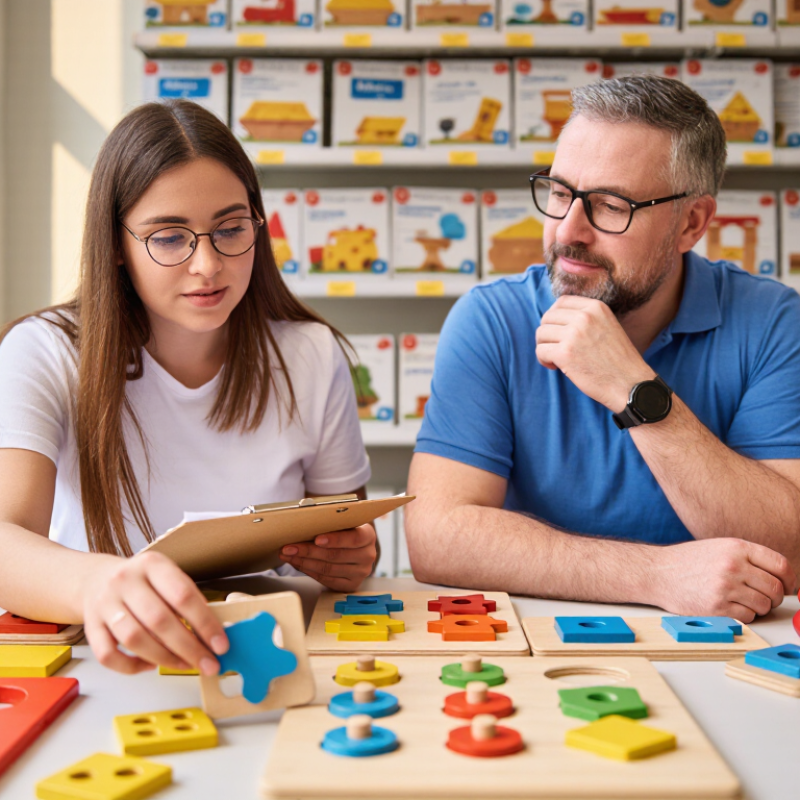
For a 2026 wholesale plan, sort learning toys by the developmental skills they invite, not just material or price. NAEYC’s four domains offer a useful lens: social-emotional, physical, cognitive, and language development. For social-emotional play, consider dolls, pretend food, and cooperative games that invite turn-taking or naming feelings. For physical development, compare chunky lacing beads, toddler-safe tongs, balance pieces, and washable art tools. Check grip size, durability, and whether parts suit the intended age group. Small details matter.
Cognitive materials can include shape sorters, matching cards, simple puzzles, and open-ended blocks. Look for more than one way to solve a task; children often use pieces in unexpected ways. Language-rich options include picture books, puppets, story stones, and listening games with clear, repeatable instructions. A toy may support several domains at once: a pretend shop uses counting, conversation, and shared roles. Categories are helpful, but not perfect. A tidy spreadsheet cannot show how children actually engage. Before placing a large order, request samples where possible, inspect construction and cleaning needs, and ask educators to trial items in real play. Observe closely. Record what holds attention, what frustrates, and what gets ignored. That evidence can shape a more balanced assortment than trend labels alone.
How to Buy Learning Toys Wholesale in 2026
Circana reported that U.S. toy retail sales reached $37.3 billion in 2023, down 8% from 2022. Yet sales remained 38% above 2019 levels, according to its U.S. Toy Industry Insights report. That distinction matters. The figure covers the whole toy market, not learning toys alone, and it measures retail sales rather than wholesale orders. Treat it as a market reference, not a sales forecast for your store.
For 2026 buying, estimate demand from your own customer mix: age groups, school calendars, average basket size, and past sell-through. A wooden counting set, for example, may attract preschool families, while science kits may sell better around holidays. Small tests help. Start with limited quantities across a few learning categories, then reorder products that move steadily. Check case-pack sizes, minimum orders, lead times, and return terms before comparing unit prices.
Circana’s market data gives buyers useful context, but broad growth can hide weak performance in a specific niche. Ask suppliers for current product specifications and age guidance, and inspect samples when possible. Track weeks of inventory, not just units sold. A forecast can still be wrong. Keep some budget for replenishment instead of committing every dollar to an opening order; slow-moving stock takes shelf space and ties up cash.
To buy learning toys wholesale in 2026, compare landed cost per sellable unit, not the supplier’s quoted unit price. Add product cost, freight, insurance, customs brokerage, duties, and port or delivery fees. Then divide by the number of units expected to arrive in saleable condition. A low unit price can hide expensive freight when bulky boxes use more container space. A higher minimum order quantity (MOQ) may reduce unit cost, but it also ties up cash and increases the risk of unsold stock.
Freight is not a fixed percentage. UNCTAD’s Review of Maritime Transport 2024 reported that the Shanghai Containerized Freight Index reached 3,475 points on July 5, 2024, more than 2.5 times its early-December 2023 level. That historical spike is a reminder to request current, itemized quotes. Duties depend on the destination country, product classification, and customs value; verify them with a qualified customs professional. A spreadsheet estimate can still miss destination charges. Leave room for surprises.
Tip: Request quotes at two order quantities and compare total cost per usable unit. Ask whether freight includes origin handling, destination fees, and final delivery. Check carton dimensions and packed weight before approving the order. Record the assumed duty rate and exchange rate beside each estimate, then update them before payment.
Compare MOQ, unit price, freight, and duties to estimate landed cost per unit.
In this illustrative scenario, estimated landed cost falls as order quantity increases, mainly because product pricing and freight per unit decrease. Duty is modeled at 5% of product value; actual rates depend on the product’s HS code, country of origin, and import destination. Confirm supplier quotes, freight, and applicable duties before ordering.
How to Buy Learning Toys Wholesale in 2026
A supplier’s safety claim is only a starting point. Ask for test reports tied to the exact toy model, materials, and production site—not a generic certificate. ASTM F963-23 is the current U.S. toy safety standard incorporated into federal requirements, covering hazards such as small parts, sharp edges, and mechanical strength. Request evidence that the product was tested against the applicable sections, including any requirements for its age range and design. Paperwork can look reassuring. Check the details.
Lead limits deserve close attention. The U.S. Consumer Product Safety Commission sets a 100-parts-per-million limit for lead in accessible toy components under CPSIA; lead in paint and similar surface coatings is limited to 90 ppm. Ask suppliers for component-level results from a CPSC-accepted third-party laboratory, and verify that the report identifies the tested materials and test methods. A finished-toy report may not clearly cover a replacement part or a changed coating. That gap matters.
Before placing a wholesale order, compare the report dates with the production run and request written notice of material changes. Confirm that the supplier can provide the required Children’s Product Certificate and supporting test records. ASTM F963-23 and CPSC guidance provide the regulatory benchmarks; neither makes supplier communication optional. Keep a sample from the batch. It is a simple check, though not a substitute for laboratory testing.
| Review Area | What to Verify | Evidence to Request | Buyer’s Acceptance Check |
|---|---|---|---|
| Applicable toy-safety standard | Confirm that the toy is evaluated against ASTM F963-23, the toy-safety specification incorporated by reference into U.S. regulations at 16 CFR Part 1250. | Test report identifying the product, model, tested age grade, test methods, standard edition, and test results. | The report covers the exact product and applicable requirements; it is not merely a generic statement of compliance. |
| Total lead in accessible component parts | For children’s products subject to the limit, CPSIA restricts total lead in each accessible component part to 100 ppm. | Component-level test results from a CPSC-accepted third-party laboratory, where third-party testing is required. | Check results against the 100-ppm limit and confirm that the tested parts match the production materials and finishes. |
| Lead in paint and surface coatings | The federal limit for lead in paint and similar surface coatings on covered children’s products is 90 ppm. | Coating test results that identify the tested finish and the relevant regulatory limit. | Review this separately from the 100-ppm total-lead limit for accessible component parts. |
| Children’s Product Certificate | For applicable children’s products, the U.S. domestic manufacturer or importer must certify compliance with relevant children’s product safety rules. | A Children’s Product Certificate (CPC) listing the product, applicable rules, manufacturer or importer, and supporting test information. | Ensure the responsible U.S. party can provide a CPC for the specific product and production version. |
| Age grading and small parts | Check that the stated age grade fits the toy’s design and intended use. Small-parts rules can prohibit small parts in toys intended for children under 3 years old. | Age-grading rationale, product specifications, and applicable small-parts test results. | Verify the age label, warnings, packaging, and test scope are consistent with the product. |
| Material and component traceability | Confirm that the tested plastics, paints, inks, metals, and other accessible components are the same as those used in the order. | Bill of materials, material specifications, component identifiers, and change-control records. | Require notice and review before material, supplier, finish, or design changes that could affect compliance. |
| Laboratory and report review | Verify that required third-party testing was performed by a laboratory accepted by the CPSC for the relevant testing scope. | Laboratory details, report number, test dates, scope, and any follow-up or corrective-action records. | Check report authenticity and scope; an unrelated or expired report does not establish compliance for a different product. |
| Wholesale order controls | Agree on the approved sample, specifications, packaging, production tolerances, and what happens if a compliance issue is found. | Purchase-order specifications, approved sample record, inspection criteria, and written corrective-action terms. | Release the order only after required documentation is reviewed and the production item matches the approved version. |
Before placing a learning-toy wholesale order, approve a production sample, not just a polished photo. Test small parts, seams, finishes, and moving pieces as a real child might use them. Check that age guidance and instructions are clear, and ask the supplier to confirm materials and quality checks in writing. Keep one approved sample for comparison when cartons arrive. It takes time. Still, it can reveal a loose wheel or rough edge before a large shipment does.
Set reorder points using actual sales, supplier lead time, and a modest buffer. For example, if a classroom toy sells 12 units weekly and replenishment takes four weeks, stock can run low before the next delivery arrives. A reorder point should cover expected demand during that lead time, plus a safety cushion based on sales variation. Review it monthly, or sooner when delivery schedules change. Forecasts are imperfect; mine have been, too.
Monitor sell-through by product and by week, rather than relying on total revenue alone. A shelf may look busy while one item barely moves. Compare units sold with units received, and note returns, seasonal spikes, and customer questions. If a shape-sorting toy slows after launch, test a smaller reorder before discounting the whole batch. Keep records simple, but consistent. Then adjust order quantities from evidence, not optimism.