



Global buyers often treat a Beachflag Pole as a simple display accessory. That assumption deserves scrutiny. A pole must withstand transport, repeated assembly, wind exposure, and different event environments. Its real value appears beside a crowded exhibition entrance, where a stable flag remains visible above moving visitors.
Industry data supports this practical focus. UFI’s Global Exhibition Barometer 2024 reported continued recovery across many exhibition markets, while organisers still identified cost control and operational efficiency as important concerns. Grand View Research also projects continued growth in the global outdoor advertising market through 2030. These findings suggest stronger demand for reusable, portable, and visually consistent display equipment. However, market growth does not guarantee product quality. Specifications still require careful checking.
This guide presents ten buying tips for international purchasers. It examines pole materials, base systems, height options, fabric compatibility, wind performance, packaging, replacement parts, and supplier communication. Look closely at aluminium wall thickness, connector tolerances, and the base’s filled weight. Small details matter. A pole that fits neatly into a padded carry bag can reduce damage during air or road transport. A water base may suit outdoor promotions, while a cross base with ground pegs may perform better on firm grass.
Do not judge suppliers by photographs alone. Request test reports, dimensional drawings, sample units, and clear warranty terms. ISO 9001 certification can indicate controlled processes, but it does not replace product inspection. One honest warning remains: the cheapest Beachflag Pole may become expensive after broken connectors, faded fabric, or missing spare parts. Reliable purchasing requires evidence, not optimistic promises.
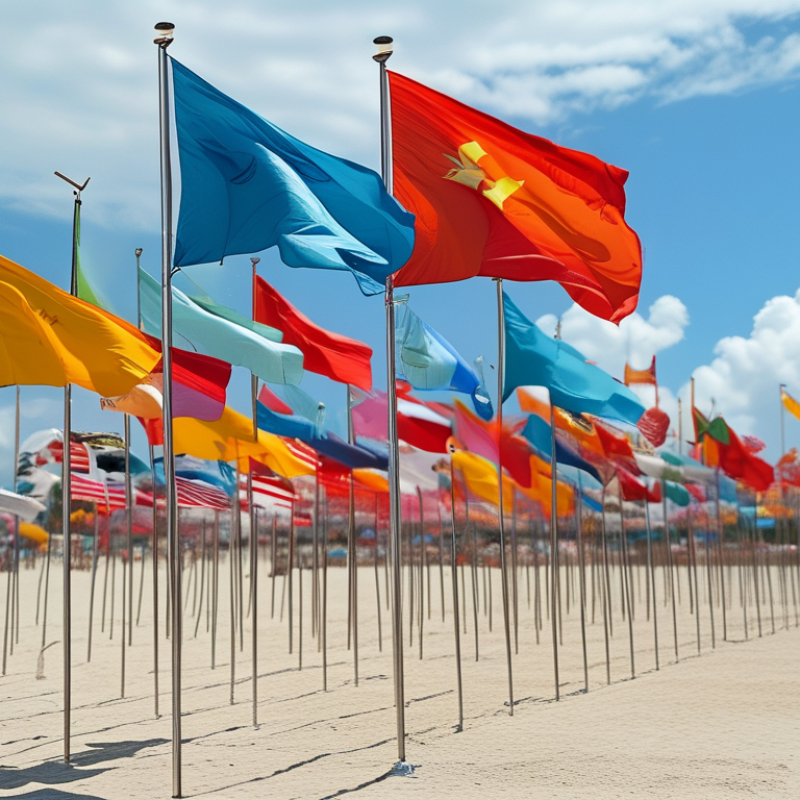
Beachflag poles are not interchangeable. Their shape, base, and fabric tension should match the installation site.
A feather flag has a curved outer edge and keeps its message visible in light wind. A teardrop flag creates a compact silhouette, while a straight flag offers a cleaner, taller display.
Curved designs usually attract attention near entrances, sidewalks, and retail promotions.
Ground-spike poles suit grass, soil, and beach sand. Push the spike deeply into firm ground, then check for movement. Cross bases work on concrete, exhibition floors, and indoor venues, but they need a flat surface. Add a water or sand weight outdoors.
Telescopic poles help transport teams fit equipment into small vehicles. They can be convenient, although more joints may mean more maintenance.
The demand for portable displays is linked to busy event and advertising environments.
The Outdoor Advertising Association of America reported U.S. out-of-home advertising revenue of about 9.1 billion dollars in 2023. The Events Industry Council also estimated that business events generated 1.6 trillion dollars in global economic output. These figures support careful equipment planning, not careless purchasing.
A beachflag beside a registration desk needs a stable indoor base. A roadside promotional flag needs stronger anchoring and weather awareness.
I have seen buyers choose a lightweight cross base for exposed pavement. It looked neat, but it shifted after one gust.
Pole selection should consider wind, surface, transport, cleaning, and replacement parts. Manufacturer wind claims still require practical verification.
10 Beachflag Pole Buying Tips for Global Buyers
Beachflag poles face wind, rain, salt, and intense sunlight. Material choice directly affects service life. Aluminum is light and corrosion-resistant, but thin tubes may bend under repeated gusts. Fiberglass flexes better and can recover from moderate wind, yet it may crack after impacts or prolonged ultraviolet exposure. Ask for wall thickness, joint strength, and documented load testing. Vague claims are not enough.
NOAA’s 2023 Billion-Dollar Disasters report recorded 28 costly weather events in the United States, a record at that time. Your market may face different risks. Coastal buyers should prioritize sealed connectors and corrosion-resistant fittings. Inland buyers may need stronger joints for sudden gusts. ISO 4892-3 and ASTM G154 provide recognized methods for accelerated UV exposure testing. These tests help, but they cannot perfectly reproduce every climate.
Tip: Request wind-test results, not only a maximum speed. Check whether the test used a complete flag, correct base, and realistic ground conditions. A pole tested without fabric may appear stronger than it is. Also inspect the base material. Steel offers stability, while water-filled plastic bases improve portability but may shift on uneven surfaces. I would avoid choosing by price alone; cheaper poles often hide weaker ferrules or brittle plastic. Still, premium materials are not automatically durable. Review repair access, replacement parts, and warranty terms before placing a global order.
Matching pole size, flag shape, and display requirements should guide every beachflag purchase. A 2.8-metre pole may suit a narrow teardrop flag, but it can look undersized beside a wide rectangular flag. Measure the visible print area, ground clearance, and packed length before ordering. For crowded entrances, a taller pole improves visibility; for indoor halls, a shorter pole reduces ceiling conflicts. Grand View Research valued the global outdoor advertising market at approximately USD 41.88 billion in 2023, showing how strongly visibility influences commercial displays.
Wind conditions matter as much as appearance. A flexible fiberglass pole can follow gusts, while a heavier base improves stability on hard surfaces. Water bases work well outdoors but become inconvenient for repeated indoor moves. UFI’s Global Exhibition Barometer has reported continued growth expectations across many exhibition markets, where fast setup and compact transport remain practical purchasing concerns. Select a cross base, ground spike, or weighted plate according to the venue, not the product photograph.
Check the flag shape carefully. A teardrop design usually keeps its outline under tension, while a feather shape needs enough pole curve to prevent fabric collapse. Confirm sleeve direction, pole-section labels, replacement availability, and washing instructions. I have seen buyers choose the tallest option, then discover poor stability and difficult transport. Bigger is not always better. Recheck the real site conditions before approving the final size.
Base selection should follow the ground, not the flag’s appearance. A cross-foot base suits paved entrances, exhibition floors, and smooth concrete. Add a weighted plate when people may brush against the display. Water-filled bases are practical, but they become weak if partially filled or poorly sealed. One litre of water weighs about one kilogram.
Use a ground spike for firm soil, grass, or compacted earth. Avoid it in concrete, buried utilities, or loose fill. A screw base usually performs better in sandy or soft ground because its helix increases soil contact. However, installation quality matters greatly. A shallow, tilted screw can fail faster than a simple spike. No base is perfect.
Wind exposure deserves more attention than many buying guides suggest. The NOAA Storm Events Database recorded 28 billion-dollar weather and climate disasters in the United States during 2023. This does not predict beachflag failure, but it shows why average weather is an incomplete reference. Check local wind data and compare the pole system with ASCE 7-22 or EN 1991-1-4 design guidance. These standards help estimate wind actions for different locations and exposure levels.
For temporary outdoor events, inspect the soil before ordering large quantities. Test one base first. Wet ground may look stable but lose strength quickly. On hard surfaces, ballast should resist sliding and tipping, not merely add weight. I would also allow a safety margin, because real sites are rarely as clean and level as product photographs.
10 Beachflag Pole Buying Tips for Global Buyers
A reliable supplier should provide factory details, material specifications, and recent production photos. Ask for a physical sample before placing a large order. Check pole length, section joints, fabric tension, stitching, and base stability. Fiberglass should flex without sharp splinters or visible cracks. Request test records for wind resistance, UV exposure, and repeated assembly. Standards differ by market, so confirm the documents with your local importer or safety adviser. Do not trust vague claims.
Compare complete landed costs, not only the unit price. Include printing, poles, bases, packaging, inspection, insurance, freight, duties, and possible storage charges. A low quotation may hide thin fabric or weak connectors. Ask whether prices cover replacement parts and corrected samples. Payment terms also matter. A reasonable deposit protects cash flow better than full payment before inspection.
Shipping requires careful measurement. A long carton can increase freight costs dramatically. Confirm carton dimensions, gross weight, loading photos, and delivery terms before production. Request commercial invoices, packing lists, and origin documents when needed. Use pre-shipment inspection for larger orders, even if it adds time. I once underestimated spare bases, and a small shortage delayed an event. That mistake still influences my buying checklist. Quality control is never perfect. Build a small allowance for damaged parts, color variation, and changing weather conditions. Reliable communication matters. Suppliers should answer clearly, record revisions, and admit limitations. That honesty is often more valuable than polished promises.
| Tip | Evaluation Dimension | Practical Benchmark or Data | What Global Buyers Should Verify | Recommended Evidence |
|---|---|---|---|---|
| 1 | Define the complete product specification | A beachflag pole normally consists of fiberglass or aluminum sections, a ground base, and a fabric flag. Common assembled heights are approximately 2.5–5.5 m, depending on the intended model. | Confirm assembled height, section count, pole diameter, total packed length, base type, fabric size, and intended installation surface before requesting quotations. | Approved technical drawing, product specification sheet, packed dimensions, and finished sample. |
| 2 | Compare pole materials and construction | Fiberglass offers flexibility and corrosion resistance, while aluminum is lightweight, rigid, and recyclable. Wall thickness, joint design, surface finish, and fiber orientation affect durability. | Ask whether sections are pultruded fiberglass, molded fiberglass, or aluminum; inspect joint fit, bending recovery, burr-free edges, and resistance to repeated assembly. | Material declaration, section sample, dimensional inspection report, and repeated assembly test. |
| 3 | Assess fabric and print quality | Outdoor flag fabrics are commonly polyester-based. A fabric weight around 110–130 g/m² is frequently used for lightweight outdoor display flags, although the correct value depends on size and wind exposure. | Verify fabric composition, weight tolerance, color consistency, double-sided requirements, bleed-through expectations, UV resistance, stitching quality, and washing instructions. | Fabric composition report, color approval sample, print proof, seam inspection, and wash or light-exposure test results. |
| 4 | Evaluate base stability and site suitability | Cross bases, ground spikes, water-fill bases, and weighted plates serve different surfaces. Water-filled bases can add substantial weight after filling, but they may be unsuitable where freezing is possible. | Match the base to grass, soil, concrete, paving, indoor floors, or temporary event sites. Review tipping resistance, drainage, portability, and compatibility with the pole diameter. | Base weight data, center-of-gravity information, stability test, installation instructions, and site-specific recommendation. |
| 5 | Request transparent pricing at each order quantity | The unit price can change significantly with quantity because printing setup, packaging, tooling, labor, and freight allocation are distributed across the order. A quotation should separate product, packaging, tooling, and logistics costs. | Compare prices at sample, 50-unit, 100-unit, and 500-unit levels where relevant. Confirm whether artwork, replacement parts, cartons, taxes, and inspection fees are included. | Itemized quotation with currency, validity period, minimum order quantity, payment terms, and clearly stated inclusions and exclusions. |
| 6 | Check supplier production capacity | Lead time is affected by material availability, printing volume, assembly, inspection, and packaging. Sample production and bulk production should be quoted separately rather than treated as one timeline. | Ask for monthly capacity, current production load, peak-season arrangements, standard sample lead time, bulk lead time, and the process for handling urgent replenishment. | Written production schedule, capacity statement, process flow, pre-production approval procedure, and delay-notification policy. |
| 7 | Calculate shipping by packed volume and weight | Freight cost depends on chargeable weight, carton dimensions, destination, transport mode, and trade term. Long pole sections may create dimensional charges even when the actual weight is low. | Obtain carton count, net weight, gross weight, carton dimensions, cubic volume, stackability, and pallet details. Compare air, sea, rail, courier, and consolidated freight when available. | Packing list, carton photos, dimensional-weight calculation, shipping quotation, estimated transit time, and destination charges. |
| 8 | Clarify Incoterms and import responsibilities | EXW, FOB, CIF, CPT, and DDP allocate transport, insurance, customs, and delivery responsibilities differently. Import duties and local taxes vary by destination and product classification. | Confirm the named place, transfer of risk, export clearance, insurance coverage, import clearance, duties, taxes, and final-mile delivery responsibilities. | Pro forma invoice, agreed Incoterm with named location, customs documentation list, tariff classification support, and landed-cost estimate. |
| 9 | Verify quality standards and inspection controls | A practical quality program should include incoming-material inspection, in-process checks, final visual inspection, dimensional checks, print-color approval, packaging inspection, and sampling criteria. | Ask which inspection standard is used, how defects are classified, what the acceptable quality limit is, and whether independent pre-shipment inspection is permitted. | Quality-control plan, inspection checklist, defect classification, test records, batch traceability, and approved pre-shipment report. |
| 10 | Review packaging, warranty, and after-sales support | Each pole section should be protected from bending, abrasion, and moisture during transport. Replacement sections, bases, clips, and fabric panels should be identifiable and orderable separately. | Confirm inner protection, carton strength, moisture control, spare-parts availability, warranty coverage, claim response time, replacement procedure, and storage conditions. | Packaging specification, drop-test or transit-test record, warranty terms, spare-parts list, claim workflow, and storage instructions. |